Showing posts with label sip and paint franchise vs independent. Show all posts

Friday, November 25, 2016

How Much Does a Paint & Sip Franchise Cost vs Independent Studio?

How Much Does a Paint & Sip Franchise Cost vs Independent Studio?

Simple answer: by "Grand Opening" you will have around $15-20k invested in an independent studio like our clients do, or at least $50-130k plus if you go the franchise route.

You may have noticed the growing trend in the past few years -- many studios jumping on the paint & sip franchising "bandwagon". The franchisor's claim is that if you pay to use their brand and model, your studio will be a guaranteed success. But you're not buying McDonald's "golden arches" that everyone knows, TV advertising and all -- most of your local potential customers just want to "paint & party", they couldn't care what flag it flies under as long as you are exceeding in customer service and have a nicely branded studio space.

The franchise fees, royalties, advertising, and other expenses that most paint and wine franchises charge franchisees cuts too far into the profits for any studio owner to make a decent return on investment (ROI) and good profit margins and doesn't provide franchisees with all of the glimmery implied guarantees of fun, success, and class volume that they experienced on their "discovery day" trip to a franchised studio or during a phone call. This article explains the business and financial dynamics of investing in a "paint and sip" studio, both independent and franchised.

How Much is the Profit for a Paint & Sip Franchisee?
Profit, defined: difference between the purchase price and the costs of bringing the service to market.
Profit margin, defined: a measure of profitability. It is calculated by finding the net profit as a percentage of the revenue.

In other words, the lower your costs, the higher the profit margin can be.

Example: Jane wants to be an entrepreneur. She plays with this, and buys a pre-made candle for $5 and then sells it to a friend for $10. It was a lot fun, and she made money doing it!

Cost price = $5
Selling price (revenue) = $10
Profit = $10 − $5 = $5
Profit percentage (profit divided by cost) = $5/$5 = 100%

Now, onto "overhead". Jane has no overhead, so her profit margin is high--
Business overhead, defined: an ongoing expense of operating a business.

If Jane pays to advertise her candles and a fee to sell them from a booth at the local market, her profit margin will go down because of the newly added "overhead". However, if she makes this move / expansion, there could be increased volume and revenue that may offset her expenses... or not, it depends on the demand, which can never be guaranteed. All small business is a risk, never a guarantee. Jane can expand, but it's in her own best interest to do this slowly, at the lowest cost and risk possible -- Rome wasn't built in a day.

How Much Does a Paint & Sip Franchise Cost vs Independent Studio?

What is the Monthly Overhead (Cost) of a Paint & Sip Studio?
An independent studio, like the ones we co-create, has many costs, but a franchise has even more, and customers just want to "paint and party" -- flying the flag of the franchise at your location isn't going to guarantee customers. Here's a list of common basic expenses for any sip and paint studio--
*Studio lease / rent
*Utilities (heat / cooling, electricity use, sometimes water / sewer fees).
*Internet

In addition, there are monthly "variable costs"--
Variable costs, defined: costs that change in proportion to the service that a business produces.

Common variable costs of paint and sip studios include--
*Art materials
*Art instructor pay

The more tickets you sell, the higher your variable costs of materials and payroll will be. But making sales is good, and these variable costs are a predictable percentage of each ticket price, although we want to keep them to a minimum because that cost cuts into profits.

Franchises add another expense to their studios, the "royalty"--
*Royalty fee, defined: payment made by one party, the franchisee, to another that owns a particular asset, the franchisor, for the right to ongoing use of that asset (using their brand, use of the paintings, etc).

There are no fees to pay with an independent studio -- you own it! Royalty fees for paint and sip franchisees are typically set at 5% to 8%, but they are also known to tack a 2% to 6% "advertising" royalty, or assess fees on alcohol sales, per sold painting, or other factors, it all depends on which paint and sip franchise.

So, with a franchise, not only do you pay $15-30k upwards for the use of their name, logo, and other benefits claimed in their "franchise fee", but you pay them a portion of every dollar you earn, as a "royalty fee", for the duration of your contract, normally 5-8 years. This adds to your costs and lowers your profit.

Return on Investment (ROI)
When you make an investment, you do so in order to profit from a "return". You expect to earn back the money you invested, within a reasonable amount of time, plus a profit for the act of investing in it--

ROI, defined: in purely economic terms, it's one way of considering profits in relation to capital invested.

When we speak of the paint and sip industry, your investment is what you put in "on the front end"  -- business licensing, obtaining the lease space, buildout and improvements, inventory, initial advertising, hires and training -- every dollar you spend to get into business. With a franchise, add their fees to it and you will find that most franchisees spend $60k to $130k by the time they have their "grand opening", that's their investment. Our independent studios spend $15-20k on average, total, depending on costs in their local market.

Naturally, each studio owner would like a "good return on investment", the question is, how long it takes until that investment, plus a return, the profit, comes -- all the while paying the monthly overhead, variable expenses, and royalty fees in a franchise?

We have given you the facts--
*customers just want to "paint & party", the flag you fly under is of no consideration to them as long as you offer a good brand and high level of customer service.
*a franchise will cost you at least five times as much an independent paint and sip studio, at a higher front end investment and variable monthly expenses, with no guarantee of more customers.

Simple story -- you can open faster and on a better budget with us, and get just as many customers as your "next door", high cost franchise as long as you follow our step-by-step advice. We've opened 30 studios in the US since 2010, who will be next?

Click the link for a side by side comparison of independent vs. franchise requirements, benefits, and costs.
How Much Does a Paint & Sip Franchise Cost vs Independent Studio?

Wednesday, November 14, 2012

Paint and Wine Locations and Branding

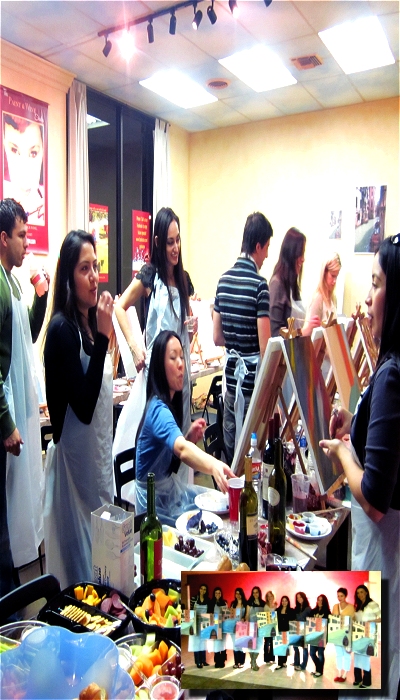
Customers at "The Paint & Wine Studio"
often drive nearly an hour to attend, passing
up several "sip & paint" businesses along
the way. It's all because of our unique brand.
One of the things I hear most often from callers is "there aren't any sip and paint businesses or franchises in our town yet", or, "there's only one and they do a lot of business". That's a fine observation, and it's important to be aware of your environment in the business marketplace, but existing presence should not be the deciding factor in whether to open a "sip and paint" oriented business-- or any other type of business, for that matter.

I like to use the analogy of an Italian restaurant, and you probably have a few of these in your own town. Maybe the simplest level is a "Fazoli's" franchise, drive-thru and all. It's Italian, fast-food style. There might be a sort of small "family-operated" eatery within minutes, not fancy but the food can't be beat, especially for the price. And then you have the "high-end" establishment, which is usually a restaurant named "Tony's", it is in St. Louis, Missouri, my hometown, where there's no lack of Italian dining establishments.

Put yourself in the customer's position-- in this scenario you have never eaten Italian food, and driving by a "Fazoli's" franchise you hit the drive-thru and enjoy spaghetti for the first time. It was quick, convenient, in a nearby location and served its purpose. Your friend mentions a Fazoli's near her house, 20 minutes across town. Will you drive there to try it? No, because the successful model of a franchised business is that you know what you're getting no matter where that restaurant or store is -- it should all be the same. You're not driving 20 minutes only to get the same food and service when it's right next door!

But, having a literal hunger to discover what else is offered in the world of Italian food, you ask your friend if they know of any other eateries -- you've already been to the franchise, you know how that tastes. Your friend mentions a "hole in the wall with the best sauce I've ever had", and you make a beeline for it. You're amazed that such a small, family-operated business can churn out such unique and delicious Italian food. Unbeknownst to Fazoli's, they just turned you on to the best marinara sauce in town by existing in the first place, and have probably lost you as a customer.

With a family event impending, and not wanting to take them to the very casual "hole in the wall", you seek out fine dining, Italian style, and phone your friend. "Go to Tony's and you'll think you're in Italy -- they have beautiful canvas paintings on the wall, the finest china and service, the food is presented as art itself, and you can even sit in an actual gondola, imported from Italy, while drinking wine -- it's heaven, a 45 minute drive for you, but the experience of a lifetime!" You could do that or take the family to the Fazoli's franchise, so the choice is obvious.

You may only get to go to "Tony's" twice a year because of the higher price and longer drive, but everyone in the radius is willing to drive the distance and pay more for the experience, so they do good volume. Tony's doesn't care where Fazoli's opens another franchise, in fact, they're happy when another Italian business opens because it leads customers on a trail -- straight to Tony's.

The moral of the story is that business branding, not franchising, is the key to success in any business. To be a success in the "paint and wine" business you need to be different from the rest, not a mere copycat of a franchise, because if you are, your potential customers might as well go to the franchised business -- they know what they get there.

Branding and developing unique paint and wine as well as other "art and entertainment" businesses is just one of our specialties offered through "The Paint & Wine Studio". Please visit this link for more information.

Tuesday, November 13, 2012

Paint and Wine Franchise "Name Fees"


The franchisee is paying to use the franchisor's name and logo and this is commonly referred to as a "name fee". Our sources tell us they are informed by competing "sip and paint" franchises that the name fee is $20-25,000 dollars on average.

My question to any potential business owner is if the franchisor's brand is well-known enough to justify the cost. If it's a "McDonalds" franchise, one of the best-known business franchises in the world, you're going to want those "golden arches" flying over the building, and it's worth the cost -- you're buying into a well-established international business franchise that everyone identifies with. 

With "sip and paint" franchises, what you're really paying in a name fee is a supposed track record of that name and logo having local appeal, not a nationally recognized brand by the common consumer, because the majority of customers are not even familiar with the concept of "sip and paint", let alone worried about a brand name. The question is if the franchised name and logo will have appeal in your own local market-- or if you can't come up with your own name and logo that is regionally desirable and brand your paint and wine business, all the while saving you $20,000 plus.

In our consulting program, we help our clients develop their business name, logo, and brand based on many factors, all proven by successful experience. The end result is a paint and wine business, name, and logo that our clients own, 100%, and at a fraction of the price of a franchise. It's like owning a "Burger King" next to a "McDonald's", before anyone knew who either company was, so it's even ground (no pun intended). From there, the client can develop several locations or franchise out their own name as desired.

To learn more about our program, please click this link

Open Your Own Paint & Wine Art Business - Not a Franchise!

Monday, November 12, 2012

Sip & Paint Business - Franchise vs Independent


Potential "paint and wine" studio business owners call daily, asking me to compare the differences between signing up with a franchise versus my independent "sip and paint" business consulting services. To understand the two different business relationships, one has to understand how a franchise works.

In a nutshell, when you become a "franchisee", you buy the rights to use the name, logo, business model, and any other proprietary business information and / or products or services that the "franchisor" offers in their contract. 

With my independent business consulting program, I help you develop your own unique business name and logo, and apply my successful business models to your unique "paint and wine" studio and local area to make your business a success.

What's the difference? About 50 to 100,000 dollars of your own investment money, and freedom, because once I co-create the business with you, you're not obligated to pay anything afterwards -- no royalties, no contracts or long-term agreements, no requirements for you to spend on advertising, it is unrestricted concerning the services and products you offer, your work hours-- you have free reign over your entire business with my program.

This is a side by side comparison I created to answer the common question of "What is the difference between an independent paint and wine business and a sip and paint franchise?".

http://www.paintandwine.com/paint-wine-business-franchise-consulting-cost.html